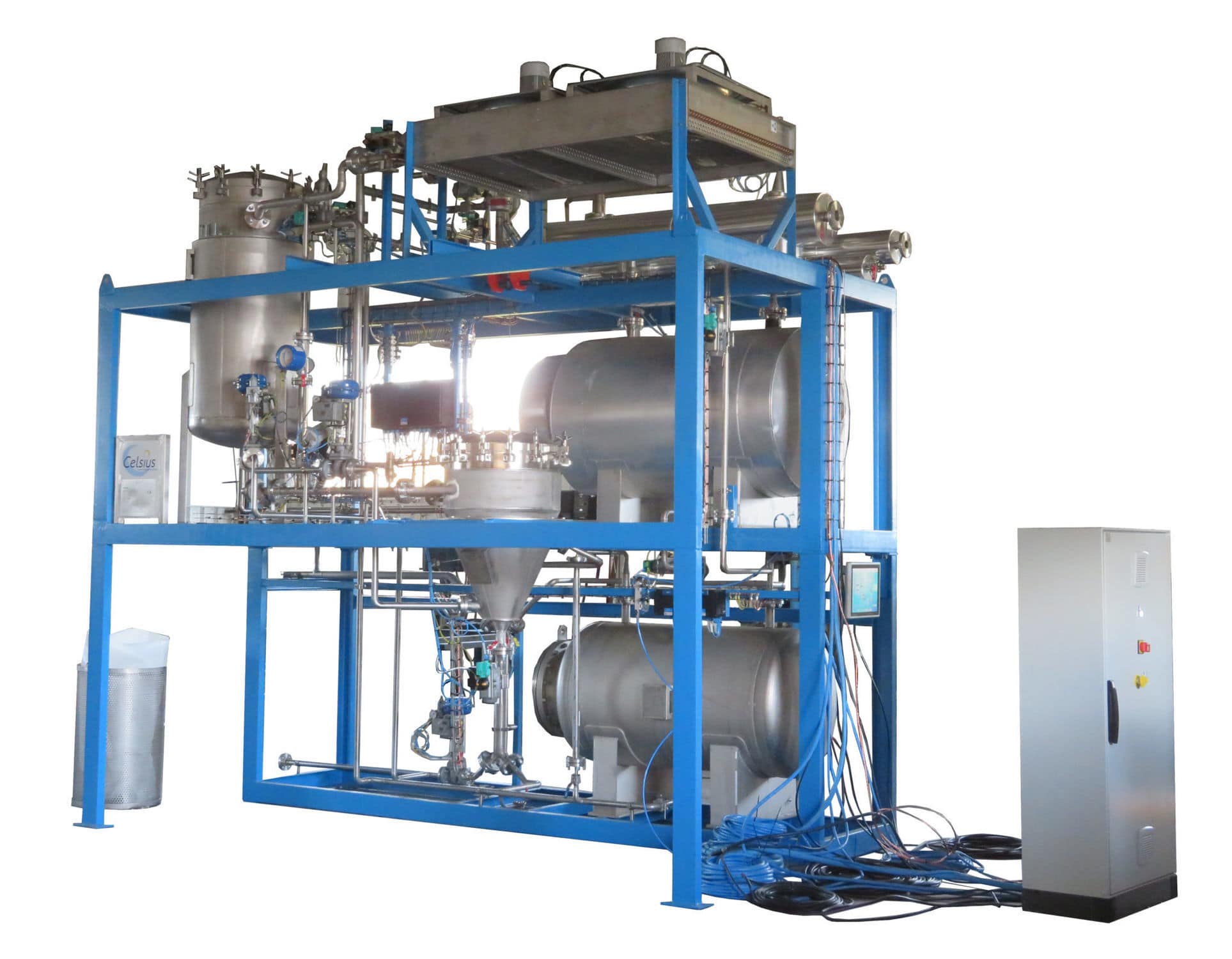
冷抽取设备 NECTACEL 用于溶剂 气体 蒸汽
品牌:Celsius process
| 技术参数 | 冷 |
| 应用 | 用于溶剂, 蒸汽, 气体, 食品工业, 化妆品产业, 用于制药业, 植物分子 |
产品介绍
Process solutions
Since its start-up, CELSIUS build equipment for the pharmaceutical industries producing active ingredients by chemical synthesis ways. But there are other ways for the production of Active Pharmaceutical Ingredients: the extraction of natural molecules. And the need is extended beyond pharmacy in the cosmetics, perfumery, flavorings, food supplement industries. For this industry, CELSIUS has developed the NECTACEL process for the extraction of natural molecules using liquefied gases.
GREEN CHEMISTRY
Nature contains a wealth of molecules with interesting properties for humans (active principles, flavour, odour, nutritional properties). CELSIUS uses plant chemistry principles to build extract, reagent, essential oil, concrete, absolute or functional ingredient production equipment. NECTACEL extraction units are designed with chemical engineering, process engineering and thermodynamics expertise, with attention to facility safety, optimised resource management, energy savings and environmental protection.
Each unit is designed for a specific matrix and extraction solvent
Steam
Water
Alcohol
Hexane, Toluene, etc.
Green solvents
Liquid gases
EXTRACTION OF NATURAL MOLECULES
By extraction of natural molecules is meant any process used to transfer molecules from a solid animal or plant substrate to a liquid phase. Depending on the trade the raw material is referred to as matrix, load, solid, plant, drug, bagasse, etc. The extraction of natural molecules more specifically relates to dissolution of molecules of interest in a solvent. The process involves two successive phases:
An extraction step: the plant or animal matrix is intimately mixed with a solvent; the molecule of interest is dissolved in the solvent. This phase is called solvation, maceration, digestion, decoction, infusion, leaching, elution, trituration, percolation, etc.
A separation step: separation of solvent from extract. The solvent is evaporated and the residual extract can be liquid (solute), solid (crystallised) or solid in suspension. This phase is referred to as evaporation, boiling, desolvation, crystallisation, etc.
SOLVENT SELECTION CRITERIA
The criteria entering into the choice of a solvent include:
The solvating power of the desired molecule (polarity, ionic character).
The solvent’s ability to cross the membrane of the cells in the matrix (molecular size).
Thermodynamic properties that define the operating conditions and technologies.
Secondary and ethical criteria: solvent selectivity (separation/purification downstream), use of renewable or recycled solvents, low energy requirements, operating at temperatures that do not degrade the product.
EXTRACTION PROCESSES
Extraction processes differ depending on whether the solvent is gaseous, solid, liquid or supercritical:
1. Hydrodistillation
Water vapour entrains the molecule of interest by forming an azeotrope. Used to extract essential oils; limited to extracts that support vapour temperature.
2. Cold enfleurage
A solid solvent process (e.g. flower petals placed on grease); difficult to industrialise.
3. Liquid solvent extraction
Common liquid solvents: water, alcohols, hexane, toluene. Solvent and solute separation requires evaporation (temperature, vacuum) and consideration of residual solvent and recycling.
4. Liquefied gases
Liquefied gases are gases under normal conditions and liquids under extraction conditions. Advantages: ability to work at ambient temperature (avoiding thermal damage), inert or green solvents, relatively low pressure compared to supercritical CO2 and often no mechanical equipment required. The general scheme: liquid solvent extraction, evaporation, condensation and solvent recycling. Process phases: extraction (raw material contact), separation (evaporator, condenser, storage), evaporator/extractor vacuum application (drying of spent raw material). At each point solvent is at evaporation equilibrium and calorific/frigoric balances are managed.
Thermodynamic selection criteria for liquefied gases
Solvent must be liquid in extractor at near-ambient extraction temperature (vapor pressure typically not to exceed ~10 bar at 35°C) and must possess a condensation temperature at atmospheric pressure reachable with conventional refrigeration (practically higher than -30°C at Patm). Two gas families considered: alkanes and authorised refrigerant gases (HFCs, HFOs).
Table: Liquid gas examples and properties
Liquid gas
Butane C4H10
R134a (1,1,1,2-tetrafluoroethane C2F4H2)
Boiling point at Patm
-0.5°C
-26°C
Vapour pressure at 35°C
2,3 barg
7,9 barg
Other extraction variants
5. R134a extraction using a refrigerating unit
The refrigerant property is used with a gas compressor (Carnot cycle); implemented at small scale with repurposed refrigeration units but with extra energy consumption for the compressor.
6. Supercritical CO2 extraction
CO2 is inert, safe, cheap; in supercritical state it is an excellent solvent and allows ambient-temperature extraction for heat-sensitive molecules. Supercritical extraction requires high pressures (in excess of 72 bar, practically 300–500 bar during extraction), increasing investment and limiting equipment capacity; suitable for reduced-size pilot units or dedicated large-scale high-value operations.
NECTACEL PRESSURISED PROCESS
The pressurised extraction process (NECTACEL) developed by CELSIUS is intended to allow extraction of any polar or non-polar plant or animal molecules. Investment cost is lower than supercritical CO2 and requires less complex infrastructure, enabling units to be implemented at raw material production sites. Liquefied gas extraction advantages: chemically inert solvents relative to matrix and extract, ambient temperature extraction and separation (beneficial for heat-sensitive molecules), small solvent molecules that pass through cell membranes, possibility of co-solvents to extend solvation, operations at relatively low pressure (
Fields of application
Cannabidiol extraction from hemp
Artemisinine extraction from artemisia annua
Oil extraction from oil cakes
Caractéristiques / spécifications techniques
Process name: NECTACEL (liquefied gas extraction process developed and patented by CELSIUS)
Manufacturer: CELSIUS
Solvents commonly used: n-butane, HFO1234ze (trans-1,3,3,3-tetrafluoroprop-1-ene), DME (dimethyl ether); other solvents: water, alcohols, hexane, toluene, supercritical CO2
Extraction phases: extraction (solvation) and separation (evaporation/condensation), with possible vacuum drying of spent matrix
Typical operating pressure for liquefied gas extraction: relatively low, generally less than 10 barg; vapor pressure criterion: should not exceed ~10 bar at 35°C
Condensation temperature requirement: practical condensation temperature must be higher than -30°C at atmospheric pressure
Equipment features: no circulation pump or gas compressor (except vacuum pump for drying), energy limited to solvent evaporation/condensation, high solvent recycling rate
Applications: pharmaceuticals, cosmetics, perfumery, flavours, nutraceuticals, food supplements
联系我们
对 Celsius process 的 冷抽取设备 NECTACEL 用于溶剂 气体 蒸汽 感兴趣?
微信扫码联系我们,获取报价与详细资料。
